Office and commercial expansion: shell construction, high-quality shell construction & full expansion
What does ‘shell construction’ mean? Avoid cost traps when searching for office space. We explain the differences between the various construction standards in Switzerland.

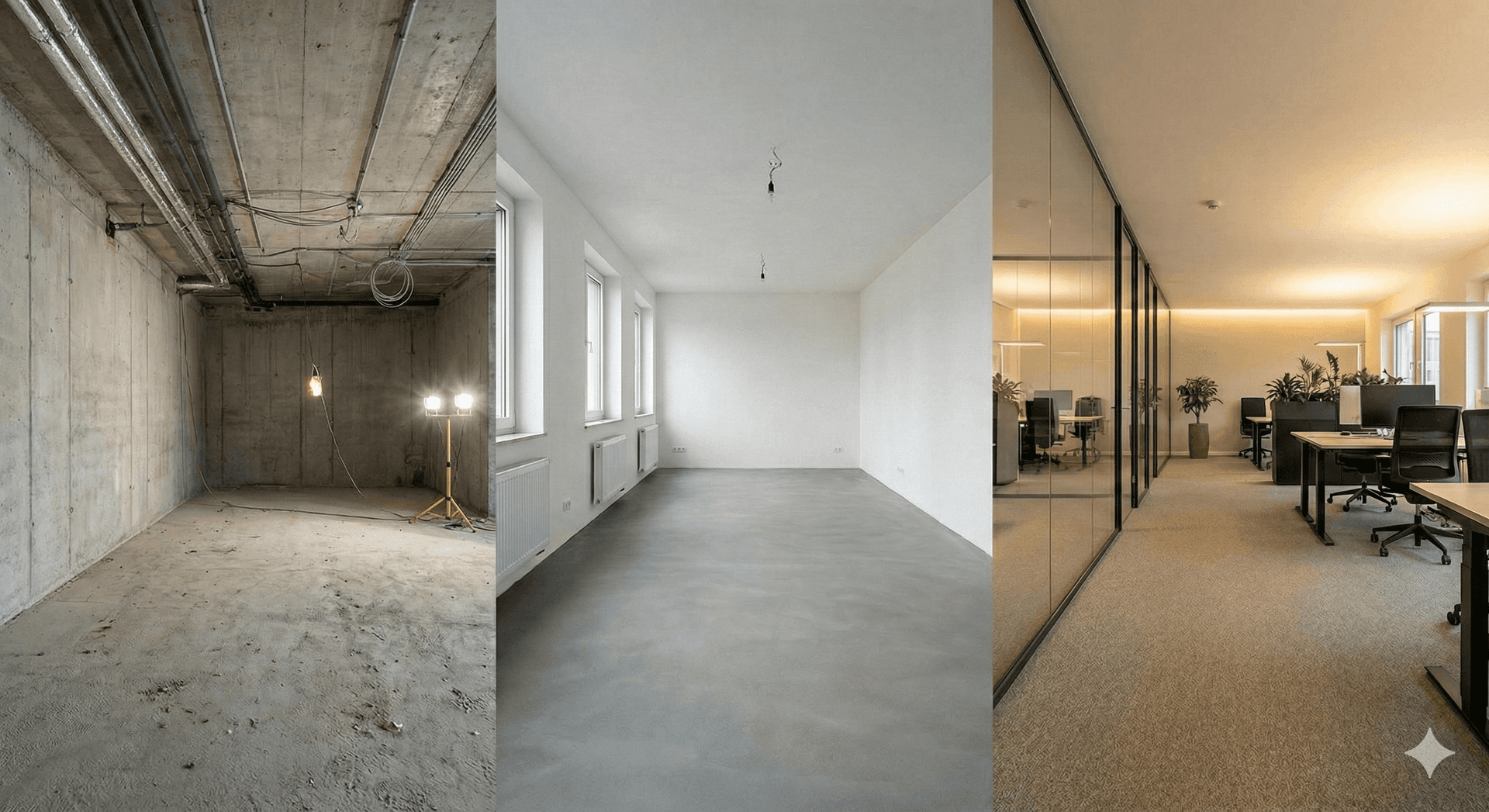
The terms used in the real estate market are not set in stone. While with shell construction you face bare concrete and usually have to invest every franc yourself for the interior fit-out, the high-end shell construction common in Switzerland already offers heating, toilets, and plastered walls. With a fully fitted space, you can start immediately, but you pay for this comfort through a significantly higher rent. Ultimately, what matters is not the keyword in the listing, but the detailed interface list in the lease agreement.
The Misconception of the Square Meter Price
Perhaps you have already experienced this situation when searching for new commercial premises: You read an advertisement for a modern office space, advertised at CHF 220.– per square meter. A real bargain. Just two clicks further, you find a comparable building, but here, CHF 380.– is suddenly being asked.
Why this huge price difference? The first price most likely refers to a shell construction, the second to a fully fitted space. Comparing apples and oranges here can quickly lead to a cost trap. To be able to work here, you need to invest a lot of money and coordinate craftsmen before even the first desk can be set up. To realistically plan your budget, it's worth taking a closer look at the three common fit-out standards.
The Shell Construction
If you enter a space in classic shell construction, you'll need a lot of imagination. You're essentially renting only the building's structure and shell. Around you, you'll see bare concrete walls and raw ceilings, and often there's no screed floor yet, but rather the bare concrete of the floor slab beneath your feet.
Almost everything that makes an office is missing here. There are no interior walls, no power outlets, and no kitchenette. Even the connections for water, electricity, and ventilation are usually only routed to a central shaft within your rented space – from there, it's your problem. This might sound daunting, but for certain tenants, it's exactly what they need. If you have very specific requirements, for example, for a laboratory, a high-tech workshop, or a showroom that must exactly match your corporate identity, shell construction is the perfect blank canvas. However, you must be aware that you will have to pre-finance the entire interior fit-out, and it can easily take six to nine months until you can move in.
The High-End Shell
In Switzerland, you will rarely encounter completely bare concrete. Here, an intermediate stage has become established, often referred to as "high-end shell" (Edelrohbau) or "enhanced basic fit-out". When you view such a space, it already looks much more inviting.
The exterior walls and the building core are already plastered and painted white, and usually, a screed floor or a technical raised floor has already been installed. The crucial difference to standard shell construction is the building services: the heating is installed and operational, the slat blinds function electrically, and the toilet facilities are fully fitted and ready for use.
For most SMEs, this is the ideal compromise. You don't have to worry about the basic infrastructure, but you still have the freedom to choose the floor covering (parquet or carpet) yourself and decide where you want to install glass walls for meeting rooms. The investment required here is significantly lower than for shell construction, and the timeline until move-in is manageable.
Fully Fitted
At the other end of the spectrum is the fully fitted space, often marketed as "Plug & Play". The principle is similar to a hotel room: you open the door, plug in your laptop, and you can start working.
In these spaces, the landlord – or often the previous tenant – has already taken care of everything. The flooring is laid, the walls are up, the kitchen is installed, and often the IT cabling is even fully routed to the workstation. This is extremely convenient and perfect for startups or rapidly growing companies that don't have time for construction projects and don't want to tie up their liquidity in drywall.
However, this convenience comes at a price. Since the landlord has made the investments, they recover this money through a higher rent. Moreover, you trade convenience for a loss of flexibility. You adopt someone else's space concept and taste. If the office layout doesn't suit you, you cannot easily change it without tearing out the expensive fit-out again.
Beware of Terminology Confusion
The biggest problem with all of this is that terms like "partially fitted" or "ready for occupancy" are not legally standardized. Every landlord and broker understands something different by them. Disputes over details arise repeatedly: Is the basic lighting still part of the landlord's fit-out, or do you have to buy the lamps? Is the ventilation sufficient only for an open-plan office, or will it break down if you install three meeting rooms?
Therefore, never blindly rely on the advertisement. The most important document for your contract negotiation is the so-called interface list. This is a table that precisely defines where the landlord's responsibility ends and yours begins. Only when it is clearly regulated in black and white who pays for the kitchenette and who is responsible for the fire doors can you plan your budget securely.
Conclusion
Choosing the fit-out standard is always a trade-off between time, money, and individuality. Do you have capital and very specific wishes? Then shell construction is your way. Do you need to start quickly and don't want to make high initial investments? Then look for fully fitted spaces. For some companies in Switzerland, however, the high-end shell offers the golden mean – a solid base with enough room for your personal touch.
Looking for the right commercial space?
Discover offices, warehouses, workshops and other commercial spaces across Switzerland.